



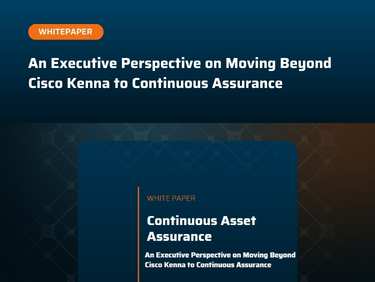
Cisco Kenna is retiring, what's next?
Don't just replace Kenna.
Upgrade to Continuous Asset Assurance.
Kenna's retirement isn't a tool swap, it's the signal to move from scanner-dependent triage to a model that continuously knows every asset, reduces real exposure, and proves control.
Native agentless discovery
Cyber Hygiene IQ Score
Closed-loop remediation
CAASM + VM + Hygiene
Request your custom ROI model
Why a like-for-like Kenna swap fails
Scanner blind spots persist
Unmanaged, unagented, and shadow assets remain invisible, just as they were in Kenna.
Remediation fatigue returns
More prioritization still produces larger queues, not less exposure on what actually matters.
Prioritization ≠ assurance
Ranking findings is not the same as proving control. Boards and auditors need evidence.
Stack grows, not shrinks
Adding another point tool increases complexity instead of solving first-gen RBVM limits.
Three Imperatives for Kenna Displacement
ApexaiQ's Kenna Displacement Assurance is built on three pillars that first-generation RBVM was never designed to satisfy.
01
Know every asset
Move from "we know what our scanners see" to "we know every asset we're accountable for." Agentless discovery across your full hybrid estate.
- Endpoints & servers
- Cloud & SaaS assets
- OT / IoT devices
- Shadow IT & unmanaged
02
Reduce real exposure
Machine-speed threats require continuously shrinking what can actually be exploited, with exploitability context, asset criticality, and risk-based paths.
- KEV & EPSS context
- Asset criticality weighting
- Risk-based remediation
- Attack path closure
03
Prove control
Evidence that remediation occurred, exposure shrank, and the hygiene story is explainable to executives, produced by controls, not assembled for audits.
- Closed-loop verification
- IQ Score 60–160
- Executive-ready narrative
- Audit-ready artifacts
ApexaiQ vs Kenna Security
| Capability | Kenna | ApexaiQ |
|---|---|---|
| Asset discovery | Scanner dependent | Native agentless discovery |
| Asset visibility | Limited for unmanaged and shadow assets | Broader estate visibility |
| Scoring | Risk-based prioritization | IQ Score plus cyber hygiene context |
| Remediation | Ticket oriented | Closed-loop verification |
| Compliance | More manual reporting | Live mapping and automation |
Replace Kenna without losing a step
A structured 10-week migration that runs ApexaiQ alongside Kenna so you see what you've been missing, before you cut over.
01
Know every asset
Inventory Kenna integrations, scanner stack, and current asset counts
Define baseline
02
Parallel run
Deploy ApexaiQ agentless alongside Kenna. See what Kenna missed in days.
Side-by-side view
03
Cut over
Redirect ticketing workflows to ApexaiQ. Kenna stays in read-only mode.
Zero visibility gap
04
Optimize
Retire redundant tools, document ROI, institutionalize IQ Score cadence.
Continuous assurance
From Kenna program cost to assurance ROI
Mid-market Kenna programs typically run $100K–$500K+/year when you include licensing, scanners, integration work, and operational labor.
Typical Kenna program costs
- Kenna licensing fees
- One or more enterprise scanners
- Integration & connector work
- Operational labor to maintain the stack
ApexaiQ displacement ROI
- Eliminates separate discovery tools
- Reduces adjacent hygiene product spend
- Consolidates vendors & integration overhead
- Proof of control = fewer audit prep costs
30–50%
Organizations can often reduce overlapping tool spend and operating effort through consolidation to a single ApexaiQ subscription.