January 23rd, 2025
“Good Enough” Cybersecurity Won’t Cut It in 2026
Doing just “enough” to protect your organization might have worked years ago. In 2026, that mindset leaves too many gaps as threats move faster than traditional tools and once-a-year audits. Cybersecurity is now a core business issue that belongs in the boardroom, not just the IT department.
Today’s leaders want clear answers:
- Are we secure?
- How sure are we?
- Where are our biggest risks right now?
Those answers require real-time visibility into your environment and proof that you are actually reducing risk, not just checking boxes. That level of confidence comes from a connected, always-current understanding of your assets and exposures—not from scattered tools and manual reports.
Cyber risk is business risk
A single breach can cause major financial damage, disrupt operations, and erode customer trust. Regulators and insurers are also raising expectations, introducing rules with serious consequences for weak cyber governance.
Executives and boards now view cybersecurity as a core part of enterprise risk management. They expect measurable data: what assets you have, which systems matter most, how exposed they are, and how quickly issues are resolved. Traditional tools often fall short because they create blind spots, keep data in silos, and rely on manual reports that are outdated as soon as they are created.
Without complete visibility, organizations are left making high‑stakes decisions in the dark.
Why traditional tools fall short
Most legacy tools were built for smaller, simpler environments. Today, organizations run on a mix of on‑premises systems, cloud services, SaaS apps, OT/IoT, and remote endpoints. Older tools are isolated tools, and often lead to:
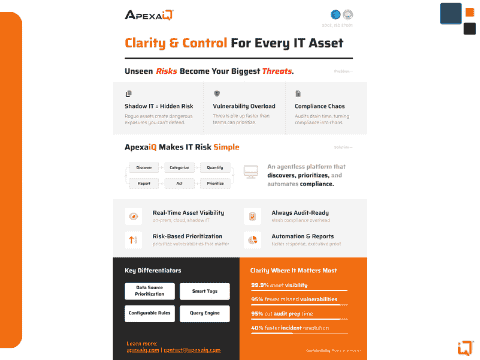
- Hidden assets: Devices, apps, or “shadow IT” no one is tracking, which become unmanaged risks.
- Fragmented data: Separate tools produce different reports that rarely align, with no single source of truth.
- No business lens: Thousands of alerts appear, but few explain which systems support revenue, operations, or compliance.
- Reactive operations: By the time teams consolidate data into spreadsheets or slide decks, the environment has already changed.
The result: security and IT teams spend more time compiling data rather than fixing operational issues, while leaders lack a reliable picture of true cyber risk.
The ApexaiQ way: from complexity to clarity
Modern cybersecurity demands continuous awareness of what you own, who owns it, and how risky it is. The most effective approaches bring data together from the tools you already use and turn it into one trusted view of your environment.
ApexaiQ was built to deliver that unified clarity. The platform continuously discovers, cleans, enriches, and aligns asset data so IT, security, and compliance teams can finally work from the same facts. That shared truth makes it easier to spot gaps early, reduce noise, and focus on work that actually lowers risk.
With ApexaiQ, organizations can:
- Discover every asset
Instantly identify devices, applications, users, licenses, and vulnerabilities—on‑premises and in the cloud—so unknown assets do not become unknown risks.
- Add business context
See which systems are critical, who is accountable for them, and how they tie to revenue, operations, or regulatory obligations, so you can understand impact, not just inventory.
- Identify and target high impact threats
Use risk‑driven intelligence to prioritize work based on business impact instead of reacting to every alert in the same way.
- Simplify audits and reviews
Generate on‑demand, auditable reports for internal leaders, regulators, and insurers using data that updates continuously, not once a year.
- Single source of truth
Rely on a single, trusted asset picture whether you are preparing for an audit, responding to an incident, navigating licensing changes, supporting customers, or working through M&A.
Context-rich and correlated, not just more data
Organizations that adopt a unified, real‑time asset view are cutting down on manual inventories and spreadsheet work while improving the quality of information shared with executives and auditors. They reduce the time it takes to prepare for reviews, improve accuracy in board reporting, and lower the risk of missing critical systems or controls.
When IT leaders can see how many assets are unmanaged, which key systems are exposed, and how quickly issues are resolved, it becomes much easier to justify investments and show progress over time. Instead of debating whose spreadsheet is right, teams align on one clear picture of risk and act on it.
Build with confidence in 2026
“Good enough” is no longer acceptable. The organizations that will succeed in the coming years are the ones that can see clearly, move quickly, and prove they are striving for operational greatness.
ApexaiQ helps you know exactly what you have, where your weak spots are, and how you are improving day by day. It turns uncertainty into control and gives teams the confidence to know their environment, protect the business, and answer tough questions from regulators, insurers, and the board.
See what confident security looks like with ApexaiQ, and move from hoping you are secure to knowing you are.